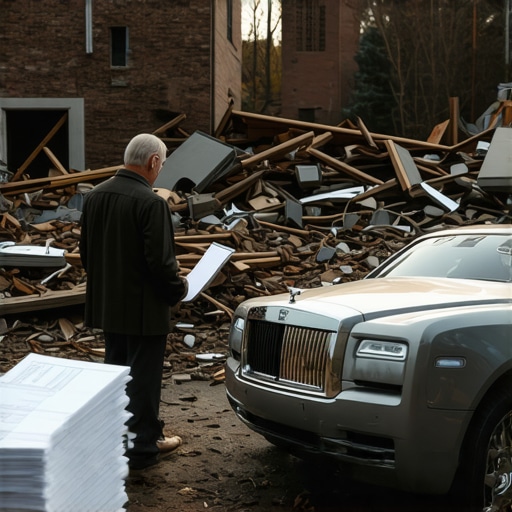
The office smells like stale black coffee and the clinical scent of laser-printed contracts. I spent a week deconstructing a high-net-worth policy after a total loss fire in a coastal suburb. The owner believed they were fully covered until they realized their guaranteed replacement cost had a cap that was set in 2012 dollars. The carrier, a household name with a five-star consumer rating, spent three months arguing over the grade of the marble in the foyer while the family lived in a rental. This is the reality of the insurance industrial complex. Ratings are a metric of marketing and financial solvency, not a promise of empathetic or even accurate claim adjudication. Most consumers buy insurance based on a television commercial featuring a friendly mascot, but they settle claims with a spreadsheet designed to minimize the loss ratio for shareholders.
The marketing mirage of high ratings
Insurance carrier ratings from major consumer groups often prioritize the speed of the initial sales process and the user interface of the mobile application over the actual indemnity performance during a catastrophic loss. A high rating generally indicates a massive advertising budget and a simplified onboarding experience for clients. These ratings rarely reflect the forensic reality of the claims department. In the actuarial world, we look at the combined ratio, which measures the money a company spends on claims and expenses versus the premiums it collects. A company with a high rating for customer service is often just a company that makes it very easy to pay your bill. When a claim occurs, that same company employs automated valuation systems that produce low-ball estimates. These systems prioritize a high volume of closed files over the accurate restoration of the insured’s assets. The consumer perceives the initial friendliness as quality, but they lack the forensic tools to see the systemic underpayment of property damage. If a carrier spends billions on prime-time advertising, that capital is being diverted from the claim-paying pool. This is a zero-sum game. Every dollar spent on a celebrity spokesperson is a dollar that will not be there to cover your roof replacement when the proximate cause is debated.
The mathematical fiction of full coverage
The term full coverage is a linguistic trap used by brokers to provide a false sense of security while ignoring the technical sub-limits and exclusions buried in the manuscript endorsements. There is no standard policy form in the residential or commercial market that provides absolute indemnity for every peril. Policies are built on a foundation of exclusions. You are not buying a list of what is covered; you are buying a list of what is not covered, with a few narrow exceptions. For example, in Florida, the current litigation crisis has forced many high-rated carriers to insert restrictive assignment of benefits clauses. These clauses prevent you from hiring a professional contractor to represent your interests during the adjustment process. If you sign a policy without reading the internal limits on mold remediation or law and ordinance coverage, you are essentially self-insuring for the most expensive parts of a claim. The actuarial logic is simple: the carrier wants to collect the maximum premium for the minimum exposure. They achieve this by using broad language in the marketing materials and microscopic language in the exclusions. A common tactic is the use of the anti-concurrent causation clause. This legal lever allows a carrier to deny a claim if a covered peril, like wind, and an excluded peril, like flood, occur at the same time. Even if the wind did 90 percent of the damage, the presence of the water can trigger a total denial of the claim.
| Policy Feature | Standard Retail Carrier | Forensic Specialty Carrier |
|---|---|---|
| Valuation Method | Actual Cash Value (Depreciated) | True Replacement Cost (No Cap) |
| Claim Adjusting | Automated/Third-Party Call Center | In-house Specialist/Senior Underwriter |
| Sub-limits | Aggressive caps on jewelry, electronics | Flexible schedules for high-value items |
| Litigation History | High volume of bad faith complaints | Low volume, focused on high-limit defense |
The three words that kill a claim
Proximate cause, depreciation, and subrogation are the three pillars of claim denial that high-rated insurance companies use to protect their profit margins. Understanding these legal concepts is the only way to navigate the adversarial nature of a high-stakes insurance recovery without losing your equity. Proximate cause is the primary event that starts a chain of events leading to a loss. Carriers will often look for a remote cause that is excluded to avoid the entire claim. For instance, if a pipe bursts because of a small amount of corrosion, they may cite the wear and tear exclusion, even if the burst caused fifty thousand dollars in water damage. This is a clinical dissection of the policy language.
“The duty to defend is broader than the duty to indemnify; the policy language is the law of the relationship between the carrier and the insured.” – Contractual Law Maxim
This maxim is often ignored by adjusters who are trained to look for any excuse to close a file without payment. They rely on the fact that most homeowners will not hire a forensic engineer or an insurance attorney to challenge their findings. The cost of the challenge often exceeds the value of the claim, which is a calculation the carrier makes before they send the denial letter. It is a game of attrition.
The ghost in the fine print
Hidden endorsements often strip away the broad protections found in the base policy form, turning a seemingly robust insurance contract into a collection of holes. These endorsements are frequently added at renewal without a clear explanation to the policyholder, representing a form of silent underwriting. In the Balkans, for example, the lack of standardized earthquake endorsements in older Sarajevo builds creates a systemic risk that standard fire policies ignore. Similarly, in the United States, carriers are increasingly adding cosmetic damage exclusions for roofs. This means if a hailstorm dents your metal roof but does not cause a leak, the carrier pays nothing, even if the value of your home drops significantly. They argue the roof is still functional, ignoring the aesthetic loss. This is a fundamental shift from the traditional concept of indemnity, which is to return the insured to their pre-loss condition.
“A policy of insurance is a contract of adhesion, and ambiguities must be construed against the drafter to protect the reasonable expectations of the insured.” – ISO Regulatory Principle
Despite this legal standard, carriers continue to push the boundaries of what a reasonable person would expect, relying on dense, jargon-filled addendums to obfuscate the reduction in coverage.
Policy Audit Checklist
- Verify the difference between Replacement Cost Value and Actual Cash Value for every asset class.
- Check for a Waiver of Subrogation that might void your coverage if you sign contracts with vendors.
- Confirm the existence of Law and Ordinance coverage to pay for modern building code requirements.
- Identify any Anti-Concurrent Causation clauses that could lead to a total denial in a storm.
- Review the specific definition of Flood and Surface Water in your regional context.
The structural reality of claim denial
The claims department of a multi-billion dollar carrier is not a service center; it is a loss-mitigation department. The adjusters are measured on their ability to settle claims within the parameters of the company’s loss-cost modeling, not on their ability to help the customer. Many people believe that paying a higher premium ensures better service, but the truth is that carriers often raise prices on loyal customers, a practice known as price walking, while simultaneously stripping away coverage in the fine print. This creates a situation where the most loyal customers have the worst protection. When you file a claim, you are entering a legal negotiation. The high-rated company uses its brand equity to lower your guard, making you more likely to accept their first, lowest offer. They use computerized estimating software like Xactimate, but they often manipulate the labor rates and material costs within the software to reflect prices from five years ago. This is how they maintain their high ratings for financial strength while providing substandard support to the people who actually need to rebuild their lives. Final assessment: the best insurance is not the one with the best commercials, but the one with the most transparent and robust contract language. Always demand a full copy of the manuscript policy, not just the declarations page, and read every exclusion as if your net worth depends on it, because it does.