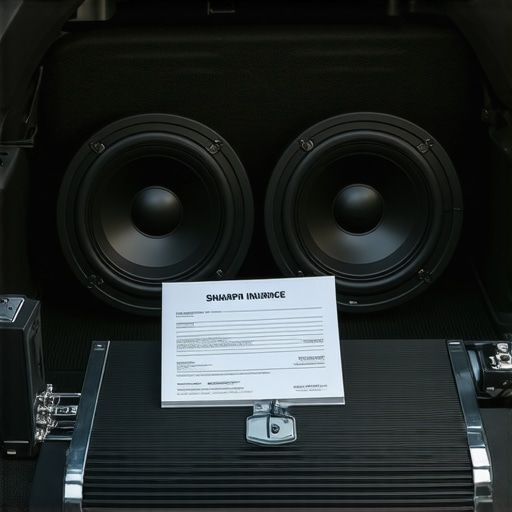
Car insurance is not a safety net. It is a legal boundary. Most drivers treat their car insurance policy like a guardian angel when it is actually a cold set of mathematical equations designed to minimize the liability of the carrier. Your custom sound system is a prime target for these exclusions because it represents a secondary risk that the original underwriting process never accounted for. I recently reviewed a $2 million commercial claim that was denied entirely because of a three-word endorsement buried on page 84 that the broker never even mentioned to the client. This level of technical betrayal is common in the world of high-end car insurance where the difference between a total loss payout and a massive personal deficit often hinges on a single sentence regarding aftermarket modifications. You might believe that your comprehensive coverage is a blanket. It is not. It is a sieve. When you install a five thousand dollar audio system, you are essentially placing a target on your financial recovery. Standard policies are written to cover the vehicle as it left the factory floor, identified by the Vehicle Identification Number. Anything added afterward is a ghost to the actuary until you force them to see it through a specific rider.
The myth of the full coverage label
Full coverage car insurance is a marketing term rather than a legal definition because it lacks a standardized regulatory meaning across the industry. Most policies marketed this way only include liability, collision, and comprehensive protections while specifically excluding aftermarket parts like high-end audio systems through restrictive definitions of covered property. You pay your premium thinking every square inch of the vehicle is protected. You are wrong. The contract is a document of limitations. When a forensic underwriter looks at your car, they see a VIN. That VIN tells the story of what the car was on the assembly line. The moment you swap the factory head unit for a high-fidelity processor or install subwoofers that required a custom enclosure, you have altered the risk profile. The carrier did not price your policy for a vehicle that contains two thousand dollars of additional copper wiring and magnets. This is the logic of the actuarially sound business model. They provide the best insurance for the average risk, but your modifications make you an outlier. In the eyes of the law, if the equipment was not permanent or factory-installed, it often falls under the Personal Effects exclusion, which is capped at a few hundred dollars or entirely eliminated if the item is bolted to the chassis. I have seen claims for stolen amplifiers denied simply because the mounting bracket was not considered a permanent vehicle integration under the strict interpretation of the ISO form.
“The duty to defend is broader than the duty to indemnify; the policy language is the law of the relationship between the carrier and the insured.” – Contractual Law Maxim
The ghost in the fine print
Exclusions for custom equipment are usually buried in the Definitions or Exclusions sections of a personal auto policy to limit the carrier’s exposure to high-value aftermarket upgrades. These clauses define custom equipment as any part or paint job not installed by the original manufacturer, effectively capping recovery at a nominal amount. This is the forensic truth of the matter. If you do not have a Custom Parts and Equipment endorsement, your sound system is a liability. Consider the math of a total loss. If your car is worth twenty thousand dollars and your sound system is worth five thousand, you expect a check for twenty-five thousand. You will receive twenty. The carrier will argue that the aftermarket system does not increase the Actual Cash Value of the car on a dollar-for-dollar basis. In many cases, they will argue it actually decreases the value by narrowing the potential buyer pool. This is the cold reality of car insurance. The legal insurance frameworks in most states, including heavy-traffic regions like California or the litigation-heavy environment of Florida, allow carriers to use these limiting endorsements to keep premiums low for the masses while penalizing the enthusiast. You must understand the difference between Replacement Cost and Actual Cash Value. Your speakers might cost five thousand to replace today, but if they are three years old, their ACV might be eight hundred dollars. Without a stated value policy, you are playing a losing game of depreciation.
The math behind the loss
Actuarial loss-cost modeling dictates that insurers avoid covering high-theft items like custom audio because the frequency of loss is significantly higher than factory components. By excluding these items, carriers maintain lower loss ratios and avoid the administrative cost of verifying the value of non-standard upgrades. When you look at the statistics, car insurance is about the law of large numbers. A standard Toyota Camry has a predictable loss cost. A Toyota Camry with a ten thousand dollar competition-grade sound system does not. The theft risk increases exponentially. The fire risk from poor wiring increases. The potential for water damage during a minor collision increases because of the modified panels. The carrier is not in the business of subsidizing your hobby. They are in the business of indemnifying a specific asset. If that asset changes, the contract should change. Most people ignore this. They spend their weekends in the garage and their Mondays in the dark. Below is a comparison of how standard vs. endorsed policies handle these risks.
| Feature | Standard Auto Policy | Custom Equipment Rider |
|---|---|---|
| Aftermarket Audio | Capped at $1,000 or excluded | Full Stated Value covered |
| Labor for Installation | Usually excluded from recovery | Included in replacement cost |
| Theft of Components | Requires proof of permanent bolt | Covered regardless of mounting |
| Subrogation Rights | Limited to factory ACV | Full recovery against third party |
The logic of stated value
Stated value coverage provides a predetermined limit of insurance for custom modifications by allowing the policyholder to declare the worth of aftermarket additions before a loss occurs. This removes the ambiguity of Actual Cash Value calculations during a claim settlement and ensures the full sound system is indemnified. Most brokers fail to explain this because it requires extra work. They would rather sell you a quick quote for car insurance than perform a forensic audit of your vehicle. A stated value policy is the only way to protect a high-end audio build. This is especially true for business insurance if the vehicle is used for professional purposes. If you are a mobile DJ or a demo car owner, a standard policy is a death sentence for your capital. You need to provide receipts, photos, and a professional appraisal. This creates a paper trail that the carrier cannot ignore. In legal insurance disputes, the presence of an appraisal is the strongest weapon against a low-ball settlement. I have seen court cases where the judge ruled in favor of the insurer simply because the owner could not prove the condition or existence of the modifications at the time the policy was issued. The contract of adhesion favors the drafter, which is always the insurance company. You must counter this by building your own fortress of documentation.
“Insurance policy ambiguity is generally resolved in favor of the insured, but clear and conspicuous exclusions are strictly enforced by the courts.” – NAIC Legal Overview
The checklist for a forensic audit
A policy audit involves a line-by-line review of the declarations page and the master policy booklet to identify hidden sub-limits on aftermarket equipment. Policyholders should focus on the definition of Covered Auto and the General Exclusions section to find language that specifically mentions non-factory parts. To ensure you are not the victim of a claim denial, follow this blunt protocol. Do not assume your agent knows what they are doing. Most are just salesmen with a license. You must be the architect of your own protection.
- Identify every non-factory component in the vehicle including head units, amps, and wiring.
- Total the replacement cost including professional labor and custom fabrication.
- Review the Limitation of Liability section in your current car insurance policy.
- Search for the term Custom Parts and Equipment or CPE in the endorsements.
- Obtain a written statement from your carrier confirming the specific items are covered.
- Verify if your deductible applies separately to the vehicle and the equipment.
- Take high-resolution photos of the installation process to prove permanent attachment.
The final actuarial word
The gap in your policy is not an accident. It is a calculated exclusion designed to protect the carrier’s profit margin. Insurance is a game of probability and contract law. If you choose to ignore the fine print of your car insurance, you are accepting a hundred percent of the risk for your custom sound system. The best insurance is not the one with the lowest monthly payment. It is the one that actually pays the claim when the speakers go silent. Stop looking at the premium and start looking at the definitions. The three words that kill a claim are often Not Factory Installed. If you see those words, your five thousand dollar system is nothing more than a donation to the insurance company. You are paying for a ghost. Demand a stated value endorsement or prepare to lose your investment. This is the forensic truth of the industry. It is clinical. It is cold. It is the reality of the contract you signed.