You built your company through decades of sleepless nights, high-stakes negotiations, and meticulous financial planning. Yet, your entire commercial enterprise remains vulnerable to a single paragraph of dry, legal prose buried on page 94 of your property policy. It is not the deductible that will ruin you, nor is it a sudden shift in the competitive landscape. It is a highly technical, industry-standard exclusion designed by forensic underwriters to protect corporate balance sheets at your expense. When the waters rise, you are not holding a safety net. You are holding a beautifully bound piece of paper that promises absolutely nothing.
The costly illusion of the comprehensive commercial package
Business insurance carriers routinely exclude flood damage from standard commercial multi-peril policies through the Water Exclusion Endorsement, forcing companies to secure separate high-cost coverage or face absolute financial ruin when water breaches their perimeter. This structural separation of perils allows insurance companies to isolate high-probability water risks while collecting substantial premiums for everyday operational hazards. If your business experiences a catastrophic water intrusion event, the standard commercial property policy will instantly reject the claim, citing the lack of a dedicated inland marine or specialized flood rider.
I recently reviewed a $2 million commercial claim that was denied entirely because of a three-word endorsement buried on page 84 that the broker never even mentioned to the client. The business, a high-precision medical manufacturing facility, suffered catastrophic water damage when an adjacent retention pond overflowed during a heavy storm. The executive team assumed their business insurance covered the loss because they had purchased what was marketed as a premier, all-risk policy. The carrier denied the entire claim, citing the phrase surface water intrusion. The manufacturer had to liquidate assets to survive. This is the brutal reality of commercial indemnity. The marketing materials promise peace of mind, but the manuscript policy delivers cold, clinical exclusion.
The fundamental misunderstanding of business insurance stems from the term all-risk. In the actuarial world, all-risk does not mean every conceivable event is covered. It simply shifts the burden of proof. In an all-risk policy, the carrier must prove that a loss is excluded, rather than the insured proving it is covered. Underwriters are exceptionally skilled at meeting this burden. They draft exclusions with microscopic precision, wrapping entire categories of physical damage in linguistic armor that no trial attorney can pierce.
The legal machinery of the water exclusion endorsement
The standard ISO water exclusion eliminates coverage for flood, surface water, waves, tidal water, overflow of any body of water, and spray from any of these sources, regardless of the proximate cause of the damage. Underwriters deploy this language to construct an absolute barrier against claims resulting from hydrological events, forcing the insured to look to federal programs or specialized secondary markets. Understanding how courts interpret these terms is the difference between surviving a storm and filing for Chapter 11 bankruptcy.
“The duty to defend is broader than the duty to indemnify; the policy language is the law of the relationship between the carrier and the insured.” – Contractual Law Maxim
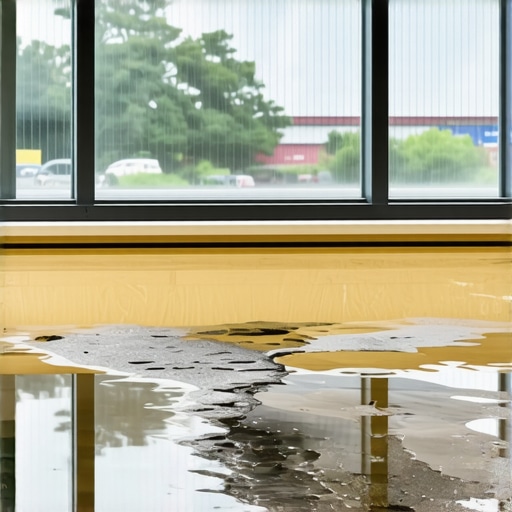
To understand the depth of this exclusion, one must examine the specific definitions. Surface water is water that diffuses itself over the surface of the ground, following no definite course or channel. It does not gather into or form a natural body of water. If rain falls on your parking lot and pools against your foundation, eventually seeping through the concrete, that is surface water. It is excluded. If a nearby creek breaks its banks and pours into your warehouse, that is flood. It is excluded. If a storm surge pushes seawater three blocks inland into your retail storefront, that is tidal water. It is excluded. The carrier does not care that a hurricane caused the storm surge. The proximate cause of the physical loss was water, and the water exclusion reigns supreme.
Carriers use anti-concurrent causation clauses to strengthen this exclusion. These clauses state that if an excluded peril (like a flood) and a covered peril (like a windstorm) occur simultaneously or in sequence to cause a loss, the entire loss is excluded. If a windstorm rips a hole in your roof and a flood simultaneously sweeps through your ground floor, the carrier will meticulously dissect the damage. They will pay for the wind-damaged roof, but the entire ground-floor inventory ruined by water will be rejected. This is the anti-concurrent causation trap. It is a legal guillotine that severs your right to recovery.
The critical differences between valuation structures
Actual Cash Value and Replacement Cost Value dictate the financial survival of your enterprise after a catastrophic event, determining whether you receive depreciated scrap value or the true cost to rebuild. Choosing the wrong valuation method in your business insurance program can result in a self-insured retention gap of hundreds of thousands of dollars when a claim is adjusted. Underwriters prefer Actual Cash Value because it limits their ultimate financial exposure by accounting for physical wear and tear over time.
| Policy Feature | Actual Cash Value (ACV) | Replacement Cost Value (RCV) | Strategic Business Impact |
|---|---|---|---|
| Valuation Basis | Replacement cost minus physical depreciation | Current cost to replace with like kind and quality | RCV prevents out-of-pocket capital drain during rebuilding. |
| Premium Cost | Typically 15% to 25% lower than RCV options | Higher upfront premium commitment required | ACV saves short-term cash flow but exposes the firm to ruin. |
| Claim Payout | Reflects real-world age and wear of the asset | Pays actual market invoices for new equipment | ACV often leaves a 50% funding gap for older machinery. |
| Co-Insurance Risk | Extremely high due to fluctuating asset values | Managed through agreed-value endorsements | Underinsurance penalties can wipe out the remaining payout. |
Consider the math of depreciation. If your warehouse roof is fifteen years old and is destroyed by a covered peril, an Actual Cash Value policy will subtract fifteen years of wear from the payout. You will receive a fraction of the cost to construct a new roof. You must cover the remaining balance from your operating cash flow. If your business does not have that capital on hand, operations halt. Your clients go to competitors. Your revenue drops to zero. This is how a business dies, not from the physical disaster, but from the depreciation calculation.
The silent threat of the sewer backup exclusion
A standard commercial property policy does not cover water that backs up through sewers, drains, or sump pumps unless you specifically purchase a sewer backup endorsement. This exclusion operates independently of the general flood exclusion, meaning a municipal infrastructure failure that floods your basement with wastewater will be denied unless the precise endorsement is active on your declarations page. Business owners often discover this omission only after their facility is contaminated with hazardous bio-hazardous waste.
Many brokers fail to explain that water damage is classified into distinct categories. Category 3 water, commonly known as black water, contains pathogenic agents and is extremely unsanitary. When a municipal main collapses, forcing sewage up through your drains, the cost of remediation is astronomical. Every porous surface must be destroyed and replaced. Standard commercial general liability will not cover this. Your business insurance property policy will point directly to the sewer and drain exclusion. You are left with a toxic facility and no insurance proceeds to fund the clean-up.
To protect your company, you must negotiate an endorsement that explicitly covers water backup and sump overflow. This coverage is usually sub-limited, meaning that even if your main building limit is $5 million, the carrier may cap sewer backup coverage at $50,000. For a business with sensitive electronics, expensive inventory, or clean-room environments, a $50,000 sub-limit is a drop in the bucket. It is virtually useless. You must demand higher sub-limits and ensure the definition of water backup includes municipal water main breaks outside your property line.
The structural audit of your commercial indemnity program
Conducting an aggressive, clause-by-clause audit of your commercial property coverage is the only reliable method to uncover hidden exclusions before a catastrophic loss occurs. You cannot rely on your broker’s assurances or the glossy summaries provided at renewal time; you must review the actual manuscript policy language. This proactive review allows you to identify coverage gaps and negotiate endorsements that match your true operational risk profile.
- Identify the exact water exclusion language in your property policy form, specifically looking for anti-concurrent causation clauses that nullify windstorm coverage.
- Verify whether your policy includes a Sewer, Drain, or Sump Pump Backup endorsement, and check the specific sub-limits associated with that coverage.
- Review your property valuation clause to confirm that all key manufacturing, warehousing, and retail locations are insured under a true Replacement Cost Value framework.
- Evaluate the potential impact of a Co-insurance clause, ensuring your scheduled asset values align with current inflationary construction and equipment costs.
- Confirm if your Business Income and Extra Expense coverage is triggered by water-related events, or if it is bound by the same exclusions as your physical property.
While most people think a higher premium means better insurance, the truth is that carriers often raise prices on loyal customers while stripping away silent coverage in the fine print. They bank on your inertia. They know that busy executives rarely read the multi-page policy booklets sent after renewal. By quietly adding restrictive endorsements, they reduce their loss-cost ratios while maintaining or increasing your premium. It is a highly profitable strategy for the carrier, but a catastrophic risk for your business.
The legal reality of the duty to defend and bad faith
Insurance companies owe a fiduciary duty to their insureds, but they will aggressively exploit ambiguous policy language to deny claims when the financial stakes are sufficiently high. When a claim is denied, your primary leverage lies in proving that the policy language is ambiguous, as courts generally interpret ambiguities in favor of the insured. Understanding the legal landscape of bad faith litigation is essential when preparing to dispute a denial.
“Insurance policies must be construed to give effect to the reasonable expectations of the insured, and any exclusions must be clear, prominent, and unmistakable.” – Landmark Appellate Court Ruling
If your carrier denies a claim, you must demand a detailed, written explanation citing the specific policy provisions they are relying upon. Do not accept a generic denial letter. Force them to define their terms. If they claim surface water caused the damage, demand their forensic evidence. Did they hire a hydrologist? Did they analyze the topography of your site? If they cannot support their denial with hard data, they may be exposing themselves to a bad faith lawsuit. Bad faith occurs when a carrier unreasonably denies or delays a claim, and it can result in punitive damages far exceeding the original policy limits. But you cannot fight them without a deep understanding of the contract you signed. The policy is the law of your relationship. Read it. Audit it. Secure the endorsements you need before the storm begins.