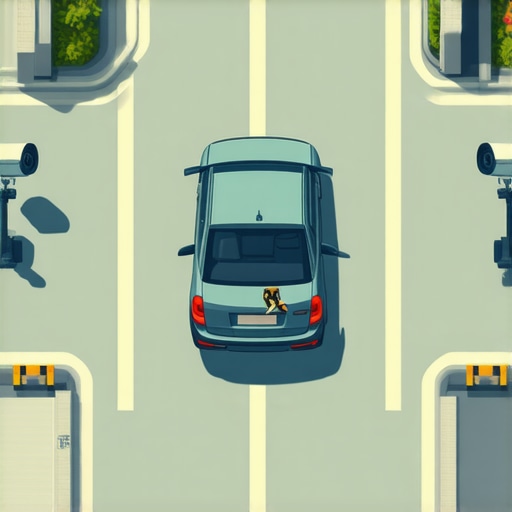
I spent a week deconstructing a high-net-worth policy after a fire. The owner thought they were fully covered until they realized their guaranteed replacement cost had a cap that was set in 2012 dollars. This same mathematical negligence applies to how drivers handle parking lot collisions. Most motorists believe that a collision on private property is a simple matter of sharing the deductible. That is a lie. It is a failure of forensic evidence. I have seen carriers deny $100,000 subrogation claims because a driver failed to document the scrape angle on a bumper. To the insurance company, you are not a victim. You are a data point in a loss-cost ratio. If you cannot prove your innocence through physics and contract law, the carrier will default to a 50/50 liability split to avoid the administrative expense of a proper investigation. This article is your manual for preventing that actuarial theft.
The ghost in the fine print
Proving innocence in a parking lot crash requires immediate preservation of digital evidence and physical telemetry. Because private property collisions often lack police reports, the carrier relies entirely on point-of-impact analysis and Event Data Recorder output to determine which party violated the Right of Way standards defined by the state vehicle code. Your policy contract mandates your cooperation, but it does not guarantee your defense against false claims from the other driver. You must act as your own forensic adjuster before you even put the car in park. The silence of a parking lot is where most claims go to die. The carrier wants a 50/50 split because it allows them to raise premiums for both parties. It is a profit center disguised as an impasse.
“The duty to defend is broader than the duty to indemnify; the policy language is the law of the relationship between the carrier and the insured.” – Contractual Law Maxim
Why your full coverage is a mathematical fiction
Your insurance policy is a contract of adhesion where the carrier holds all the mathematical leverage. When you claim you have full coverage, you are likely ignoring the subrogation waiver or the Actual Cash Value depreciation schedules that trigger the moment your fender is crushed. In a parking lot, the absence of witnesses creates a vacuum that carriers fill with comparative negligence. In states like North Carolina or Alabama, even 1 percent of fault can bar you from recovery. This is why you must treat the crash site like a crime scene. A scrape that moves from front to back on your vehicle proves you were stationary or established in the lane. A scrape that moves from back to front proves you were the striking force. The physics do not lie, even when the other driver does.
| Evidence Type | Legal Weight | Actuarial Impact |
|---|---|---|
| Dashcam Footage | Highest | Eliminates Comparative Negligence |
| EDR Data | High | Proves Speed and Braking Patterns |
| Paint Transfer | Medium | Identifies Point of Impact |
| Store Video | High | Establishes Right of Way |
The three words that kill a claim
The phrase I am sorry constitutes a legal admission of liability that overrides almost any forensic evidence. In the world of high-stakes indemnity, those three words are a gift to the other party’s legal team. They represent a voluntary assumption of liability which can actually void your own carrier’s duty to defend you. If you apologize, you are effectively telling your insurer that they must pay out. Instead, speak only in terms of the environment. The sun was in my eyes is a statement of fact. My brakes felt soft is a mechanical disclosure. I am sorry is a financial surrender. Insurance is not about being neighborly. It is about the transfer of risk. If you admit fault, the risk stays with you, and your premiums will reflect that for the next three to five years.
- Photograph the final resting position of both vehicles before moving them.
- Capture the distance between the crash and the nearest stop sign or feeder lane.
- Identify every security camera in a 360-degree radius of the impact.
- Document the weather conditions and any obstructions like overgrown bushes.
- Obtain the other driver’s insurance card and license without engaging in a debate.
The path to total indemnification
Obtaining a total recovery from a parking lot collision requires you to invoke the Last Clear Chance doctrine. This legal principle suggests that even if you were technically in a position of peril, the other driver is liable if they had the final opportunity to avoid the crash. If a car backs out of a space while you are driving down a feeder lane, they are 100 percent liable. However, if you saw them backing out and had time to honk or stop but failed to do so, a clever adjuster will pin 20 percent of the fault on you. You must prove you had zero opportunity to evade. Use your phone to record the sightlines from the other driver’s seat. If their windows are tinted beyond legal limits, that is a statutory violation that shifts the liability. This is how you win. You do not win by being right. You win by making it more expensive for the insurance company to fight you than to pay you.
“The insurer must give at least as much consideration to the welfare of its insured as it gives to its own interests.” – National Association of Insurance Commissioners (NAIC) Standard
Comments
One response to “How to Prove Your Car Was Not at Fault in a No-Witness Parking Lot Crash”
This post really highlights the importance of immediate and thorough documentation after a parking lot accident. I found the emphasis on digital evidence particularly insightful; many people don’t think about recording the scene or taking photos before moving the vehicles. In my personal experience, having clear dashcam footage was the key to proving my innocence in a similar situation where the other driver claimed I ran a stop sign. It’s also interesting how states’ laws, like North Carolina, can impact fault determination even with minimal negligence. I wonder, how many drivers are actually aware of the specific laws around speeding, stopping, or tinted windows that could shift liability? Do most people know they should record sightlines or check for camera coverage at the scene? It seems that the best way to protect yourself is to treat every crash like a forensic investigation and act quickly to preserve evidence. Has anyone else experienced a case where physical or digital evidence turned the tide in their favor? It’s a good reminder that patience and preparedness can make all the difference when dealing with insurance claims.