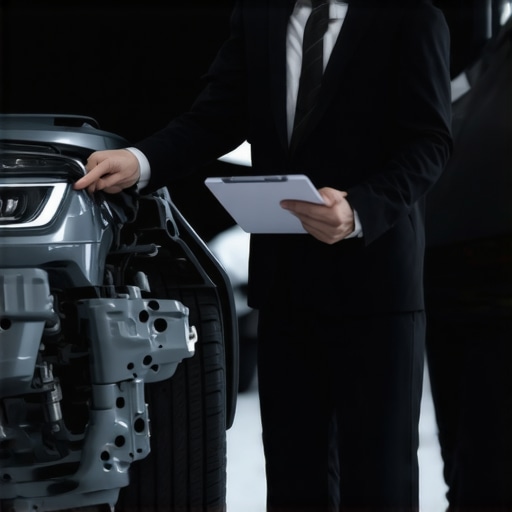
The illusion of the shiny fender
Fighting your car insurance company over non-original parts requires a clinical understanding of the ‘Like Kind and Quality’ clause in your policy contract. To win, you must prove that the proposed aftermarket component is not a functional or safety equivalent to the Original Equipment Manufacturer (OEM) part. I spent a week deconstructing a high-net-worth policy after a collision claim. The owner thought they were fully covered until they realized their repair estimate was padded with ‘certified’ parts from a factory in a country that does not follow North American safety standards. The carrier saved four thousand dollars. The client inherited a car that no longer had the same crash-pulse signature. This is the reality of the modern claims engine. It is a profit-maximizing machine. Your policy is not a promise of restoration. It is a contract of indemnification. Most people do not know the difference. The difference is the quality of the steel in your hood.
The actuarial math behind the aftermarket discount
Insurance carriers use non-original parts to reduce the ‘severability of loss’ by an average of thirty percent per claim to maintain their loss-cost ratios. These savings are rarely passed to you in premium reductions but are instead used to offset corporate underwriting leakage. Look at the numbers. A genuine BMW headlamp costs eighteen hundred dollars. A CAPA-certified alternative costs four hundred. The carrier justifies this by claiming the parts are identical. They are not. The optics are different. The plastic degrades faster under UV light. Actuaries know this. They price the risk based on the cheapest possible fix that satisfies the minimum legal definition of ‘repair.’ They call this ‘economic efficiency.’ I call it a breach of the implied covenant of good faith.
“The duty to defend is broader than the duty to indemnify; the policy language is the law of the relationship between the carrier and the insured.” – Contractual Law Maxim
The legal anatomy of Like Kind and Quality
The term ‘Like Kind and Quality’ or LKQ is the legal loophole carriers use to avoid paying for OEM parts on any vehicle older than the current model year. You must challenge the ‘quality’ aspect by documenting physical deviations in fit, finish, and structural integrity. If the part does not line up within two millimeters of the factory spec, it is not of like quality. If the metal is a different gauge, it is not of like kind. You must demand a specification sheet for the aftermarket part. Compare it to the OEM technical manual. Most adjusters have never seen a technical manual. They only see the price on their estimating software. You have to be the forensic expert they didn’t expect to meet.
| Part Category | Source | Warranty Implications | Safety Rating |
|---|---|---|---|
| OEM | Vehicle Manufacturer | Full Factory Support | Crash Tested |
| Aftermarket (LKQ) | Third-Party Factory | Varies by Vendor | Certified (Sometimes) |
| Salvage/Recycled | Junkyard/Donor Car | Minimal to None | Original but Used |
Why the repair shop is your only ally
Your repair shop manager is the only person who sees the physical failure of non-original parts during the installation process. You must authorize them to stop work and document every instance where an aftermarket part requires ‘modification’ to fit. If a mechanic has to drill a new hole in a bracket to make a bumper stay on, that part is not a direct replacement. That is a modification. Most insurance contracts do not allow for ‘modified’ repairs. They allow for ‘replacements.’ This is your leverage point. Tell the adjuster that you will not accept a vehicle that has been modified to accommodate substandard parts.
“Standard policy language typically limits the insurer’s liability to the ‘amount necessary to repair or replace the property with other of like kind and quality.’” – ISO Policy Form Overview
The hidden cost of structural integrity
Non-original structural parts like crumple zones and reinforcements can alter the timing of airbag deployment in a secondary accident. This creates a massive liability for the carrier that you can use as a bargaining chip during the negotiation. Car manufacturers spend billions on crash testing. Aftermarket companies do not. If your car is involved in another wreck and the airbags fail to deploy because the ‘savings’ bumper didn’t trigger the sensor correctly, who is liable? Mention the words ‘negligent entrustment’ and ‘product liability’ to your adjuster. Watch how fast they suddenly find the budget for an OEM part. They are terrified of future litigation that exceeds the value of the claim.
How to force an OEM endorsement
To prevent this fight in the future, you must purchase an OEM Parts Endorsement which explicitly states that only original parts will be used regardless of the vehicle’s age. This usually adds less than ten dollars a month to a premium. Most brokers ignore this. They want to show you the lowest possible quote to close the sale. They are quote-churners. They don’t care about your resale value. If you don’t have this endorsement, you are at the mercy of the ‘prevailing competitive price.’ This is a fancy term for the lowest bid. Here is your audit checklist for your next claim:
- Request a copy of the ‘certified’ part’s crash test data.
- Demand a written guarantee that the part does not void your vehicle’s factory warranty.
- Check the thickness of the paint on the aftermarket part versus the original.
- Review the ‘Diminished Value’ report after the repair is completed.
The Balkan risk of recycled components
In regions with less stringent oversight, such as the Balkan states or parts of Eastern Europe, the prevalence of ‘grey market’ parts is high, making the rejection of non-original parts a matter of basic survival. If you are driving in Sarajevo or Belgrade, the likelihood of receiving a part that was scavenged from a write-off is significantly higher than in regulated markets. You must be even more vigilant. The lack of a centralized tracking system for parts means you could be buying a safety hazard. Always check the serial numbers. If the serial number is ground off, refuse the repair immediately. The carrier is trying to bury their risk in your engine bay. Do not let them. The contract says they must restore you to your pre-loss condition. A car with third-party fenders is not in its pre-loss condition. It is a mathematical fiction. “