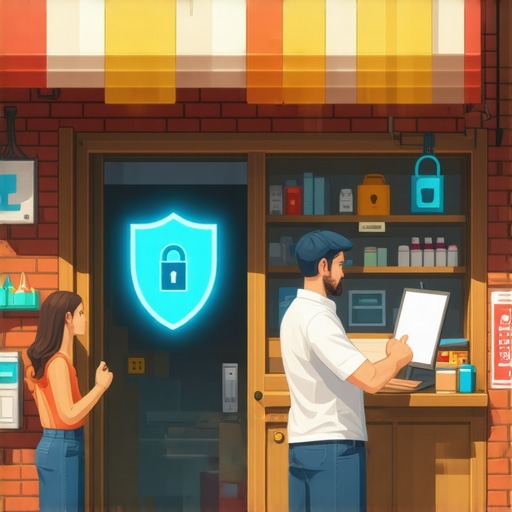
The digital ghost in the physical shop
Local brick and mortar shops face higher existential risks from cyber events than from physical fire because digital assets lack the tangible protections of a sprinkler system. Small business owners often believe that having a physical storefront protects them from the digital storms that ravage global corporations. This is a fatal misconception. I spent a week deconstructing a high-net-worth business policy after a breach. The owner thought they were fully covered until they realized their guaranteed replacement cost had a cap that was set in 2012 dollars. Even worse, their General Liability policy had a silent exclusion for any data loss that did not involve physical damage to the hardware itself. The carrier denied the claim. The business folded in three months. The forensic reality is that every credit card swipe and every email address stored on a local hard drive is a liability waiting to explode. Most owners rely on a standard General Liability form which was written when a breach meant someone broke a window. Today, the breach happens through the guest Wi-Fi or a smart thermostat. The carrier knows this. They have stripped the coverage out of the base forms. You are likely flying blind without a dedicated cyber manuscript.
The three words that kill a claim
Standard General Liability policies specifically exclude data as tangible property, meaning your insurance carrier will likely deny coverage for a server ransom or a data theft event. The phrase ‘tangible property loss’ is the anchor that allows carriers to walk away from your digital disaster. If your data is encrypted by ransomware, nothing physical was destroyed. The hardware still exists. The electrons just moved. Under the CG 00 01 form, this does not constitute property damage. I have sat in rooms where business owners wept as they realized their three million dollar policy would not pay a single cent for a fifty thousand dollar ransom. The actuarial math is cold. If it is not tangible, it is not covered. You are paying for a fortress that has no roof. Cyber liability fills this gap by defining data as a covered asset. Without it, you are self insuring a risk that has a higher frequency than catastrophic fire. The market for small business insurance is currently a race to the bottom where prices stay low because the coverage is practically nonexistent. Do not let a friendly broker tell you that you are fine. Read the exclusion section of your policy. Look for the words ‘Access or Disclosure of Confidential or Personal Information’. If you see them, you are exposed. It is that simple.
“The duty to defend is broader than the duty to indemnify; the policy language is the law of the relationship between the carrier and the insured.” – Contractual Law Maxim
The arithmetic of a small scale data breach
Small business owners typically underestimate the cost of a data breach by a factor of ten, failing to account for forensic investigators and legal notification mandates. When a local shop is hit, they think of the ransom. They do not think of the seventy five dollars per record cost for notification and credit monitoring. If you have a thousand customers, that is seventy five thousand dollars in immediate, non-negotiable costs. The law does not care if you have the money. State statutes mandate the notification. Then comes the forensic autopsy. You cannot just wipe the drive and start over. You must prove what was taken to avoid massive regulatory fines. A forensic expert costs three hundred dollars an hour. A typical investigation takes forty hours. You are down twelve thousand dollars before you even tell the customers their data is gone. Most local shops operate on thin margins. A sixty thousand dollar unbudgeted expense is a death sentence. Cyber insurance provides the liquidity to survive these moments. It provides the legal team and the forensic team as part of the service. You are not just buying insurance. You are buying an emergency response team that you could never afford to keep on staff. The premium is a fraction of the cost of a single hour of a specialist attorney’s time.
| Risk Category | General Liability | Cyber Liability |
|---|---|---|
| Ransomware Payments | Excluded | Covered |
| Forensic Investigations | Excluded | Covered |
| Legal Notification Costs | Not Covered | Covered |
| Business Interruption | Physical Only | Digital Covered |
The subrogation trap in your software contract
Software vendors frequently include indemnity waivers that prevent your insurance company from suing the vendor when their code causes your data breach. I watched a client lose their right to recover damages from a negligent contractor because they signed a waiver of subrogation in a simple service contract without realizing they were voiding their own insurance coverage. When your Point of Sale system fails because of a known vulnerability that the vendor ignored, your insurance company wants to go after that vendor. This is called subrogation. If you have signed away that right in the fine print of your software agreement, your insurer may deny your claim. They will argue that you prejudiced their rights of recovery. This is a technical trap that destroys small businesses every day. You must audit your vendor contracts with the same intensity that you audit your tax returns. The forensic trace of a breach often leads back to a third party. If that third party is legally untouchable because of a contract you signed, you are the one left holding the bill. Cyber liability policies often have specific language that helps navigate these contractual minefields, but you must be proactive. The insurance carrier is looking for reasons to not pay. Do not give them a reason on page one hundred of a vendor agreement.
“Insurance is a contract of utmost good faith, yet the burden of proof for coverage always rests with the insured party.” – ISO Underwriting Standard
A checklist for the paranoid business owner
Every local business must perform a rigorous audit of their insurance portfolio to identify the silent exclusions that make their coverage a mathematical fiction. Use this list to verify your actual standing with your carrier before a disaster strikes.
- Review the definition of Tangible Property in Section II of your GL policy.
- Check for the ‘Access or Disclosure of Confidential or Personal Information’ exclusion.
- Verify if your Business Interruption coverage requires ‘Physical Damage’ to trigger a claim.
- Identify the sub-limits for ransomware and social engineering fraud.
- Review all vendor contracts for ‘Waiver of Subrogation’ clauses.
- Confirm that your policy covers ‘Non-Physical’ business income losses.
The legislative reality of digital negligence
State legislatures are increasingly passing strict data privacy laws that hold small business owners to the same standard of care as multi-billion dollar corporations. In many regions, the ‘Valued Policy Laws’ that protect you during a fire do not exist for digital assets. You are judged by the standard of ‘Reasonable Care’. If you do not have encrypted backups and a formal security policy, the court will find you negligent. The insurance carrier will then use that negligence to argue that you violated the terms of the policy. It is a pincer movement. On one side, the state is fining you for a breach. On the other side, the carrier is denying the claim because you didn’t follow best practices. This is why cyber liability is non-negotiable. It forces you to meet a minimum standard of security just to get the policy. That standard is your best defense in court. The carrier becomes your partner in compliance. While most people think a higher premium means better insurance, the truth is that carriers often raise prices on loyal customers while stripping away silent coverage in the fine print. You need a forensic eye on your policy every single year. The risk is evolving faster than the paper it is written on. If your policy is more than twenty four months old, it is likely obsolete. Stop treating insurance like a utility. It is a legal battlefield. You are either armed or you are a victim.