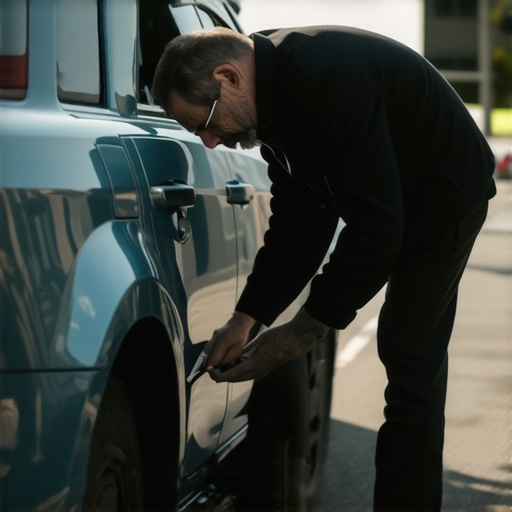
The fiction of the minor accident
A minor fender bender is a legal trigger for contract fulfillment that requires immediate forensic documentation to prevent rate surcharges. The term minor is a subjective label that carriers ignore. Every impact represents a potential for latent bodily injury claims and subrogation litigation that can inflate your risk profile for sixty months. I watched a client lose their right to recover damages from a negligent contractor because they signed a waiver of subrogation in a simple service contract without realizing they were voiding their own insurance coverage. This happens in car insurance with terrifying frequency. You shake hands with a stranger. You agree to leave the police out of it. You think you are being a good neighbor. In reality, you are a walking liability. You have just violated the notice of loss provision in your policy. The insurance company is not your friend. It is a pool of capital managed by algorithms designed to minimize outflow. When you fail to document the scene with the cold precision of a forensic investigator, you are handing the carrier a reason to re-rate your policy into a higher risk tier. I have seen premiums double because a driver could not prove the other party was speeding in a parking lot. The math of the premium is not about what happened. It is about what you can prove happened.
“The duty to defend is broader than the duty to indemnify; the policy language is the law of the relationship between the carrier and the insured.” – Contractual Law Maxim
The trap of the verbal agreement
Verbal agreements at the scene of an accident are legally unenforceable and often constitute a breach of the cooperation clause in your insurance contract. If you tell the other driver it is okay, you are essentially assuming the risk. In the world of underwriting, this is a moral hazard. The carrier calculates that a driver who handles claims privately is a driver who hides risks. Your pure premium, which is the amount of money needed to cover losses, is based on predictable data. When you create a data vacuum by not reporting or poorly documenting a fender bender, the carrier fills that vacuum with the highest possible risk rating. They assume the worst. They assume there is frame damage. They assume there is a lingering soft-tissue injury. They will increase your expense loading to compensate for the uncertainty. The only way to combat this is through a radical adherence to the documentation protocol. You must treat the street corner like a crime scene. Collect the telemetry. Take the photos. Ignore the social pressure to move the cars until the evidence is recorded. Your wallet depends on your ability to be a hard-nosed clerk in a moment of chaos.
The mathematics of the premium surcharge
Insurance surcharges are calculated based on the loss ratio and the probability of future claims which often results in a 20% to 40% rate increase. Most drivers believe the deductible is their only cost. This is a mathematical fiction. The real cost is the five-year aggregate increase in your premium. If you pay $2,000 a year and receive a 30% surcharge, that minor dent just cost you $3,000 in additional premiums over five years. This is why the forensic truth is the only thing that matters. Carriers use an experience rating system. Your past behavior is the only metric they trust. If the accident is coded as at-fault because you lacked the evidence to prove otherwise, you are categorized with the reckless. There is no middle ground in the actuarial tables. You are either a safe risk or a tainted risk. The difference is often a single photograph of the skid marks or the position of the sun. I have reviewed files where a claim was denied because the driver did not note the presence of black ice, allowing the carrier to argue the driver was traveling too fast for conditions. The insurer is looking for any reason to shift the loss cost back to you.
The hidden clauses in a standard ISO form
The ISO standard personal auto policy contains specific language regarding the duty to report which can void coverage if a minor accident is hidden from the insurer. Many policies state that the carrier has no duty to provide coverage if the failure to comply with the reporting duties is prejudicial to the company. If you wait three weeks to report a fender bender because the other driver stopped answering their phone, the carrier can argue their ability to investigate was compromised. They will deny the claim. Now you are facing a legal bill and a repair bill on your own. This is the subrogation trap. Your insurance company has a right of subrogation, which means they stand in your shoes to sue the other party. If you signed a piece of paper at the scene or accepted a small cash payment, you have destroyed their subrogation rights. This is a material breach of contract. They will cancel your policy. In the Balkanized market of modern insurance, a cancellation for cause is a death sentence for your rates. You will be forced into the non-standard market where the premiums are predatory and the coverage is thin.
| Impact Variable | Actuarial Weight | Risk Category Shift |
|---|---|---|
| Parking Lot Tap | Low | Standard to Preferred |
| Moving Violation | High | Standard to High Risk |
| Hidden Frame Damage | Critical | Total Loss Potential |
| Unreported Incident | Extreme | Policy Rescission |
A checklist for the scene of the impact
A forensic audit of the accident scene must be performed immediately to preserve the integrity of your insurance rating and legal standing. Do not rely on memory. Adrenaline is a poor historian. Follow this protocol without deviation:
- Photograph the four corners of both vehicles, even the parts that are not damaged.
- Record the street signs, traffic signals, and any obstructions to the line of sight.
- Capture the license plates and the insurance cards of all parties involved.
- Identify any witnesses and record their contact information immediately.
- Note the exact time, weather conditions, and road surface state.
- Do not apologize. An apology is often interpreted by adjusters as an admission of liability.
The ghost in the fine print
The fine print of your policy often contains a diminished value exclusion that prevents you from recovering the lost resale value of your vehicle. Even if your car is repaired perfectly, it now has an accident history. In the secondary market, this car is worth 15% less. Standard policies do not cover this loss. This is the information gain most brokers hide. You are paying for a replacement cost policy, but you are losing actual cash value in the long run. If you are not the at-fault party, you must pursue the other carrier for diminished value. Your own carrier will not help you with this. They are only interested in the physical repair. The forensic underwriter knows that the true cost of an accident is the delta between the pre-accident value and the post-repair value. If you do not document the pristine condition of your car before the repair, you have no leverage. You are essentially subsidizing the insurance company’s profit margin with your car’s equity. This is the clinical reality of the industry. It is a game of pennies played with thousands of dollars of your money.
“The rate of premium is determined by the loss experience of the classification to which the risk belongs.” – ISO General Principles
Why your full coverage is a mathematical fiction
The term full coverage is a marketing myth because every policy has sub-limits, exclusions, and conditions that narrow the scope of indemnity. There is no such thing as being fully covered. You have a contract with specific limits. In a fender bender, those limits are tested. If the other driver is underinsured, you fall back on your own UM/UIM coverage. But if you have low limits there, you are exposed. The forensic truth-teller knows that the premium you save today is the coverage you will miss tomorrow. A minor accident can quickly escalate if the other party hires a lawyer who specializes in soft-tissue miracles. Suddenly, your $25,000 limit is gone. The carrier will pay the limit and walk away, leaving you to defend the excess. This is why you must document the lack of injury at the scene. If the other driver is walking around and texting, film it. That video is worth more than the insurance policy itself. It is the only thing that will stop a fraudulent bodily injury claim from skyrocketing your rates for the next decade. Insurance is not a safety net. It is a legal battlefield where the person with the best data wins.