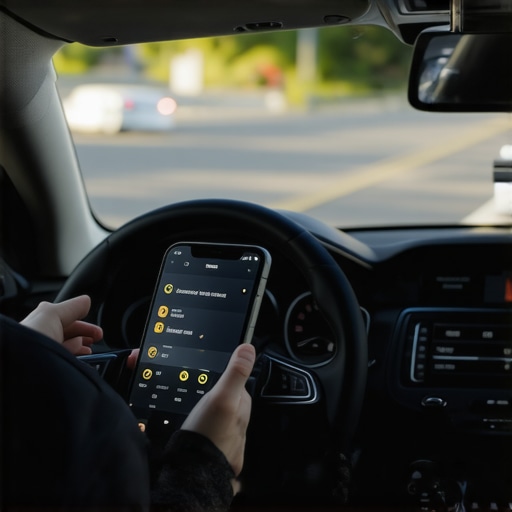
The ‘In-Car Subscription’ Trap That Quietly Raises Your Insurance Rates
I watched a client lose their right to recover damages from a negligent contractor because they signed a ‘waiver of subrogation’ in a simple service contract without realizing they were voiding their own insurance coverage. The carrier lied. They claimed the insured had compromised the company’s ability to seek recovery, and thus, the $450,000 claim was dead on arrival. This same logic is now being weaponized in the world of car insurance through the Trojan horse of in-car subscriptions. You think you are simply paying for heated seats or an upgraded navigation package. In reality, you are likely signing a data-sharing agreement that serves as a continuous, forensic underwriting audit of your driving habits. This metadata is not static. It is a live feed into the actuarial machines that determine your risk profile.
The digital ghost in your dashboard
Car insurance providers utilize telematics data from in-car subscriptions to monitor braking patterns, acceleration spikes, and nighttime driving. This metadata allows insurance carriers to adjust premiums based on predictive modeling and actuarial risk assessments that are often hidden from the policyholder within the terms of service.
The mathematical reality of modern indemnity is cold. Carriers operate on a combined ratio, seeking to keep losses and expenses below the total premiums collected. When you activate a subscription for ‘Performance Mode’ or ‘Advanced Autopilot,’ you are not just buying code. You are opting into a sensory network. This network records your velocity relative to posted limits, the G-forces exerted during a turn, and even the frequency with which you engage safety overrides. For a forensic underwriter, this is a goldmine. For you, it is a liability. The contract you signed with the manufacturer often contains clauses that allow the sale or sharing of this ‘anonymized’ data to third-party exchanges. These exchanges are the secret source for your car insurance carrier’s next rate hike. They do not need to prove you had an accident; they only need to prove your behavioral data suggests a higher probability of one.
“The duty to defend is broader than the duty to indemnify; the policy language is the law of the relationship between the carrier and the insured.” – Contractual Law Maxim
Why your dashboard is a forensic witness
In-car subscriptions create a digital footprint that car insurance companies use to verify claim validity and risk exposure. By analyzing biometric data and usage patterns, insurers can identify policy violations or high-risk behaviors that justify premium increases or claim denials during the forensic investigation.
Examine the ISO Form PP 00 01, the standard personal auto policy. It defines ‘occupying’ and ‘use’ of a vehicle in broad terms. Now, consider how a subscription service for ‘Driver Assistance’ interacts with these definitions. If the software logs that you had the system engaged but were not touching the steering wheel for eighteen seconds before an impact, the carrier may argue ‘Gross Negligence’ or a violation of the ‘Expected or Intended’ injury exclusion. They will cite the manufacturer’s own subscription terms which state the driver must remain ‘fully engaged.’ By paying for the subscription, you have effectively installed a witness against yourself. This is the best insurance strategy for the company, and the worst for the individual. Legal insurance experts are already seeing a surge in cases where ‘In-Car Metadata’ is subpoenaed to disprove a driver’s testimony about their speed or attention level. The ‘black box’ is no longer a hidden module; it is the entire infotainment system you pay $15 a month to access.
| Subscription Feature | Actuarial Risk Impact | Potential Premium Increase |
|---|---|---|
| Remote Start / Climate | Theft Risk / Keyless Vulnerability | 2% – 4% |
| Performance Tuning | High-Velocity Probability | 12% – 18% |
| Driver Assist Plus | Distracted Driving Proxy | 5% – 8% |
| Live Navigation | High-Traffic Exposure Data | 3% – 6% |
The subrogation trap in software updates
Subrogation rights allow an insurance carrier to pursue a third party that caused a loss to the insured. When car insurance policies involve in-car subscriptions, a waiver of subrogation buried in the software agreement can prevent the insurer from recovering costs, leading to claim rejection.
In Florida, the litigation crisis has reached a boiling point where the ‘assignment of benefits’ is a ticking time bomb. If your car’s software fails and causes a crash, but your subscription agreement mandates ‘Binding Arbitration’ and ‘Waiver of Class Action,’ your insurance carrier’s subrogation department finds itself neutered. They cannot sue the manufacturer to get their money back. What do they do? They look for a reason to deny your claim instead. They will point to the fine print on page 84 of the digital manual. They will claim that by ‘modifying’ the car’s operating parameters via a subscription, you have moved the vehicle into a ‘Specialty or Modified’ category not covered by your standard car insurance policy. This is the ‘silent’ stripping of coverage. It is efficient. It is clinical. It is profitable for everyone except you. Business insurance experts have warned about this for years in the commercial fleet sector, but now it has migrated to the suburban driveway.
- Review the ‘Data Sharing’ section of your vehicle’s mobile app.
- Opt out of ‘Insurance Score’ or ‘Safe Driver’ programs within the car’s settings.
- Audit your policy for ‘Telematics Endorsements’ that you did not explicitly request.
- Check for ‘Usage-Based Insurance’ (UBI) clauses in your renewal documents.
- Confirm if your carrier receives ‘Trigger Event’ data from the manufacturer.
The mathematical fiction of full coverage
Full coverage is a mathematical fiction because insurance policies are limited by exclusions, deductibles, and actual cash value calculations. In-car subscriptions add a layer of contractual complexity that can trigger coverage gaps when software failures occur during a loss event.
The actuarial weight of a software update is rarely considered by the consumer. However, a ‘Version 2.1’ update to your braking logic changes the risk profile of the asset. If you fail to download a ‘Required’ update because your subscription lapsed, and you subsequently rear-end a vehicle, the carrier will argue you failed to maintain the vehicle in a ‘seaworthy’ or ‘roadworthy’ condition. This is a classic forensic pivot. They transition from a simple accident to a maintenance failure. In the Balkans, the lack of standardized earthquake endorsements in older builds creates a systemic risk, but in the United States, the lack of standardized ‘Software Indemnity’ endorsements in auto policies creates a digital void. Your health insurance will cover your broken leg, but your car insurance might leave you holding the bag for the $80,000 Tesla you just totaled because you didn’t pay for the ‘Premium Connectivity’ package that included the latest sensor calibration. This is not about safety. It is about the loss cost multiplier. It is about the data.
“The policy language is the primary determinant of the insurer’s obligation, and any ambiguity is typically resolved in favor of the insured, yet the introduction of third-party digital contracts creates a secondary legal framework that complicates this duty.” – National Association of Insurance Commissioners (NAIC) Analysis