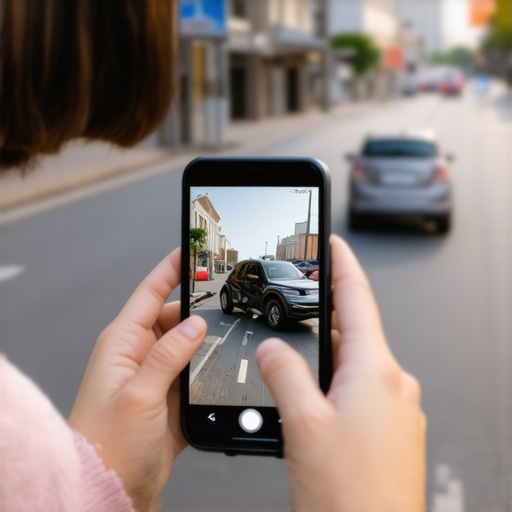
I watched a client lose their right to recover damages from a negligent contractor because they signed a waiver of subrogation in a simple service contract without realizing they were voiding their own insurance coverage. This happens daily in the world of car insurance. You think you have a simple fender bender. You take two photos of a scratched bumper. You think you are done. In reality, you have just handed the carrier a dozen ways to deny the claim. Your phone is not a camera. It is a forensic data collection tool for the legal battlefield. Most people use it wrong. They capture the surface but miss the proof. If you want the best insurance recovery, you must document the physics and the metadata of the event before the vehicles move an inch.
The forensic truth of the mobile lens
To document a fender bender using your phone, you must capture high-resolution wide-angle shots of the entire scene, close-ups of specific point-of-impact damage, and internal dashboard indicators. You need to record the license plates, the VIN of all vehicles, and the environmental factors like road signs or signals. This data creates a mathematical record of proximate cause that adjusters cannot ignore. When we talk about car insurance, we are talking about the contract of indemnity. The contract requires proof. Your phone provides the evidentiary weight needed to trigger the duty to pay. Most drivers fail to document the absence of damage on the other vehicle, which is a massive mistake. You need to prove what did not happen just as much as what did happen to prevent fraudulent injury claims later.
“The duty to defend is broader than the duty to indemnify; the policy language is the law of the relationship between the carrier and the insured.” – Contractual Law Maxim
The metadata that wins the subrogation war
Metadata includes the GPS coordinates, time stamps, and camera settings embedded in your digital photo files. These data points prove the exact moment and location of the collision, preventing the carrier from arguing that the damage occurred at a different time or place. In business insurance and commercial auto lines, metadata is the first thing a forensic underwriter examines. If the timestamp does not align with your police report, the claim is flagged for fraud. This is why you must never use third-party filters or editing apps before sending photos to your car insurance carrier. Raw files are the only currency that matters in a court of law. I have seen thousand-dollar claims denied because the EXIF data suggested the photo was taken three days after the reported incident. The phone is a witness that never lies, provided you do not interfere with its internal logging.
The math of the minor impact
The math of a fender bender involves calculating the force of impact through the depth of plastic deformation and the alignment of the bumpers. Forensic adjusters use your photos to estimate the change in velocity, known as Delta-V, to determine if the reported injuries are physically possible. People often assume that because they have the best insurance, the carrier will just take their word for it. This is a mathematical fiction. Carriers look for any reason to lower the loss reserve. If your photos show a four-inch scratch but the other driver claims a total loss, the math does not add up. You must photograph the ground. Debris patterns, fluid leaks, and skid marks tell the story of the impact force. This is as much about legal insurance as it is about property damage. You are building a defense against future litigation.
| Evidence Type | Actuarial Value | Legal Weight |
|---|---|---|
| Wide-Angle Scene | High | Establishing Context |
| Point of Impact | Critical | Determining Liability |
| Metadata/GPS | Highest | Verifying Authenticity |
| Other Driver ID | Medium | Party Identification |
| Road Conditions | Medium | Mitigating Factors |
The exclusion that hides in your digital gallery
Policy exclusions for pre-existing damage are the primary weapons used by carriers to reduce your payout. By documenting the clean areas of your vehicle alongside the new damage, you prevent the adjuster from claiming the entire bumper was already compromised before the accident. This is where the forensic truth-teller sees the most blood. You think you are covered for a new bumper, but the carrier sees a tiny rust spot from three years ago and depreciates your claim by fifty percent. This logic applies to health insurance too. If you are injured, the documentation of the accident scene provides the mechanism of injury that your doctors need to prove the claim is not related to a pre-existing condition. Documentation is the only way to bypass the clinical skepticism of the claims department. Without clear photos, you are at the mercy of the carrier’s internal math.
“Insurance is an aleatory contract where the parties involved do not have equal stakes, and the insurer’s obligation depends on the occurrence of an uncertain event.” – ISO Regulatory Guide
- Capture the four corners of both vehicles before they are moved.
- Photograph the VIN through the lower driver-side windshield.
- Record the other driver’s insurance card and license using the macro lens.
- Take a video walking around the entire scene to capture the ambient noise and traffic signals.
- Document any street signs, weather conditions, or obstructions to visibility.
- Check for dashcam footage or nearby security cameras on storefronts.
- Photograph your own dashboard to show the odometer and any warning lights.
The trap of the recorded statement
Recorded statements are often used to lock you into a narrative that can be picked apart later. Instead of relying on memory, use your phone’s notes app to write down the facts immediately while the adrenaline is still high. This written record, combined with your photos, serves as your official stance. In the Balkans, or any region with complex local legislation, the lack of standardized documentation can lead to years of litigation. In the United States, your car insurance carrier will use your own words against you if they deviate from the physical evidence. The phone allows you to keep the facts straight. Do not admit fault. Do not say you are fine. Simply say the evidence is in the photos. This is the most clinical way to protect your capital. The best insurance is the one you never have to fight to use because your documentation made the fight impossible for the carrier to win.