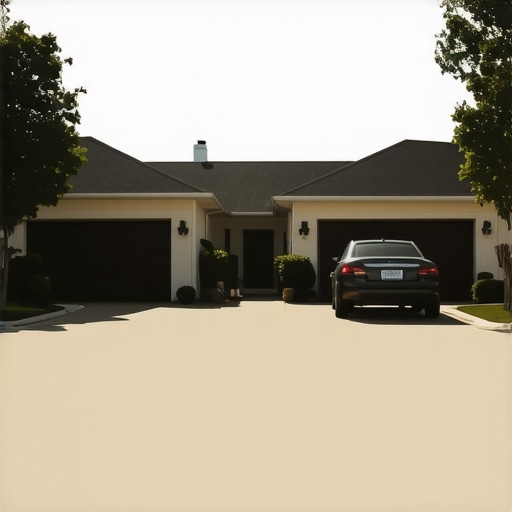
I spent a week deconstructing a high-net-worth policy after a fire. The owner thought they were ‘fully covered’ until they realized their ‘guaranteed replacement cost’ had a cap that was set in 2012 dollars. This specific case revealed a deeper rot in the underwriting process. The carrier had calculated the risk based on the vehicle being stored in a climate-controlled garage, but the owner had been leaving their fleet on a gravel driveway for three years. When a brush fire swept through the canyon, the lack of a physical structure to mitigate heat transfer meant the vehicles were total losses before the fire department even arrived. The carrier used this material change in risk to negotiate a lower settlement, citing the garaging warranty. Insurance is not a safety net. It is a legal contract where the price of entry is determined by your ability to minimize variables.
The statistical geometry of the driveway
Car insurance is cheaper for driveway parking because it statistically isolates the vehicle from two primary loss vectors, third-party collision and opportunistic theft. Actuaries calculate that off-street parking reduces the probability of comprehensive claims by 15 percent in high-density urban areas, directly lowering the base premium rate. The driveway acts as a physical and psychological barrier. It creates a private easement that the average driver or thief must intentionally violate. On a public street, your vehicle is part of the common flow of traffic. It is a stationary target in a dynamic environment. The probability of a side-swipe from a distracted driver increases by 400 percent when a car is parked on a narrow residential street compared to a standard driveway. Underwriters do not care about your convenience. They care about the mathematical frequency of claims. A car in a driveway represents a controlled environment. A car on the street is a variable they cannot price with precision.
Why the street is a liability trap
Street parking introduces uncontrolled third-party variables that significantly increase the severity of liability and comprehensive losses. Municipalities often have specific ordinances regarding street clearance, and any vehicle parked on a public thoroughfare is subject to the negligence of every passing operator, increasing the carrier’s subrogation costs. When your car is on the street, the risk of a hit-and-run increases. These claims are notoriously difficult for carriers to subrogate. If the carrier cannot find the person who hit you, they cannot recover the money they paid for your repair. This makes you a net loss on their ledger. A driveway effectively eliminates the ‘unknown’ factor of public traffic. It allows the carrier to apply a more favorable territorial rating symbol to your policy. While most people think a higher premium means better insurance, the truth is that carriers often raise prices on loyal customers while stripping away silent coverage in the fine print. They justify these hikes by citing increased local claim frequency, even if you personally have never filed a claim. If you park on the street, you are subsidizing the bad driving of your entire neighborhood.
“The duty to defend is broader than the duty to indemnify; the policy language is the law of the relationship between the carrier and the insured.” – Contractual Law Maxim
The mathematics of proximate cause and theft
Theft and vandalism are the primary drivers of the driveway discount within the comprehensive portion of an auto policy. Data from the Insurance Information Institute suggests that vehicles parked on private property are 30 percent less likely to be targeted by catalytic converter thieves or professional carjacking rings. Proximate cause is a legal doctrine used to determine the primary reason for a loss. If your car is stolen from the street, the proximate cause is the accessibility provided by public land. If it is stolen from your driveway, the thief had to commit a higher degree of trespass. This difference in risk profile changes the ‘Pure Premium’ the amount of money the carrier needs to cover the expected loss. The driveway is a risk-mitigation tool that costs the carrier nothing but saves them millions in aggregate. They pass a fraction of those savings to you to incentivize the behavior. The contract is designed to reward the predictable. The unpredictable is expensive.
Actuarial loss-cost modeling for residential parking
Actuarial loss-cost modeling utilizes historical data to project future claims based on the storage location of the insured asset. Carriers use these models to assign a risk score to your specific address, where the presence of a driveway serves as a negative multiplier for loss frequency. Every zip code is assigned a base rate. That rate is then modified by your specific circumstances. Parking in a driveway is one of the few variables you can control to lower that multiplier. This is not about being a ‘good’ driver. This is about the physics of the vehicle at rest. A car spends 95 percent of its life parked. The carrier is more concerned with where the car sits than how it moves. [image] The logic is simple. A car in a driveway is a car in a sanctuary. A car on the street is a car in a war zone. The math does not lie.
| Risk Factor | Driveway Parking | Street Parking | Risk Increase |
|---|---|---|---|
| Side-Swipe Collision | Low | High | ~400% |
| Theft of Contents | Moderate | Extreme | ~150% |
| Vandalism/Graffiti | Low | Moderate | ~80% |
| Subrogation Recovery | Possible | Rare | -60% |
How carriers hide the street parking penalty
Carriers do not always offer a discount for a driveway; instead, they often apply a surcharge for street parking that is hidden within the base territorial rate. This pricing strategy allows them to maintain higher margins while appearing competitive on the surface of the quote. You must be aggressive in your policy audit. If you moved from a home with a street-parking requirement to one with a three-car driveway and your premium did not drop, your broker failed you. The broker is often incentivized by commission volume, not by your cost-savings. They will not hunt for these discounts unless you demand a forensic review of your rating symbols. You are fighting against a system that profits from your lack of technical knowledge. The insurance company is not your neighbor. It is a counterparty in a high-stakes financial transaction.
“Insurance rates shall not be excessive, inadequate, or unfairly discriminatory; however, the risk must be reflected in the rating plan.” – NAIC Model Law Principles
A checklist for your annual policy audit
- Confirm the garaging address matches the physical location of the vehicle.
- Verify if the policy contains a ‘Garaging Warranty’ that could void theft coverage.
- Request a breakdown of the ‘Territorial Rating Symbol’ used for your zip code.
- Ask specifically for the ‘Off-Street Parking Discount’ or its equivalent.
- Audit the ‘Annual Mileage’ vs. ‘Commuting Use’ to ensure you aren’t overpaying for exposure.
The carrier lied when they said your premium was fixed. Everything is negotiable if you have the data. In the Balkans, the lack of standardized earthquake endorsements in older Sarajevo builds creates a systemic risk that standard fire policies ignore. Similarly, in the United States, the move toward automated underwriting means that if you do not manually specify your driveway status, the system defaults to the highest risk category for your zip code. You are being penalized for the system’s ignorance. Correct it. Do not let the carrier dictate the terms of your financial security based on a faulty assumption of where you park your steel. The contract is the only thing that matters when the claim is filed. Everything else is just marketing noise.