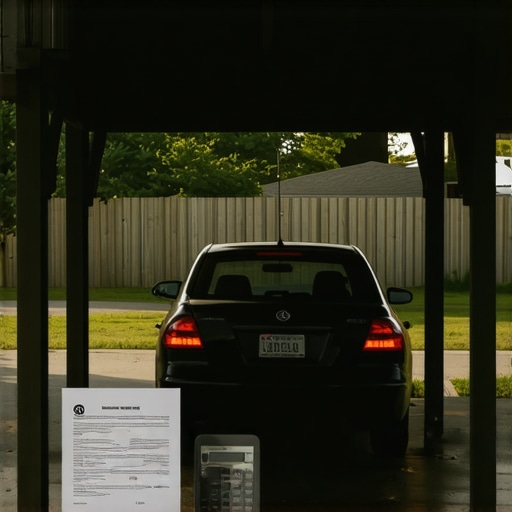
I spent a week deconstructing a high-net-worth policy after a fire. The owner thought they were fully covered until they realized their guaranteed replacement cost had a cap that was set in 2012 dollars. The vehicle in question was a vintage 911 that sat in a climate-controlled garage. It had not been driven in months. Because the owner failed to update the garaging location and usage status, the carrier attempted to deny the claim based on a material misrepresentation of risk. This is the reality of the insurance industry. Carriers are not your friends. They are balance-sheet protectors. When you have a vehicle that you do not drive daily, you are likely overpaying for risk that the carrier is not actually carrying. The math is simple. The exposure is lower. Yet, without the right endorsements, you are paying for the probability of a daily commute that never happens.
The parked asset problem
Insuring a vehicle with limited usage requires moving beyond standard continuous-coverage models. You must utilize specialized endorsements like storage-only coverage, pay-per-mile telemetry, or agreed-value collector policies to avoid overpaying for risk that does not exist while the car is stationary. Standard car insurance is built on the assumption of daily exposure. Actuaries look at the law of large numbers. They assume you are on the road for at least 12,000 miles a year. When you park a car, you change the risk profile from a kinetic liability to a static asset. The carrier still wants the premium for the kinetic liability. You must force the adjustment. This requires a forensic look at your policy declarations page. Look for the mileage bracket. If it says 12,000 to 15,000 miles and you drive 2,000, you are subsidizing every other driver on the road. This is a transfer of wealth from the disciplined to the negligent. Best insurance is not the cheapest; it is the most accurate to the underlying probability of loss.
Why your standard carrier hates your garage queen
Standard insurance companies prefer predictable, high-volume data. A car that sits in a garage represents a data anomaly. They cannot track your habits as easily. They cannot predict the exact moment a rodent will chew through a wiring harness or a pipe will burst in the garage. These are static risks. Most car insurance policies are weighted heavily toward collision and liability. When a car is stationary, the primary risks are comprehensive. Fire. Theft. Vandalism. Act of God. If you are paying for high-level collision coverage on a car that never leaves the driveway, you are wasting capital. The industry calls this premium leakage. I call it professional negligence on the part of your broker. Legal insurance requirements vary by state, but most require at least a minimum of liability coverage if the car is registered. However, if the car is truly out of commission, you can often pivot to a storage-only policy. This strips away the liability and collision components, leaving only the comprehensive protection.
“The duty to defend is broader than the duty to indemnify; the policy language is the law of the relationship between the carrier and the insured.” – Contractual Law Maxim
The storage trap in ISO forms
Most people do not realize that insurance forms are standardized by the Insurance Services Office. The ISO form is the DNA of your policy. For vehicles not driven daily, the lay-up period is a critical technicality. A lay-up period is a specific timeframe where the car is declared out of use. In exchange, the premium is slashed. But there is a trap. If you take that car out for a quick spin on a sunny Saturday during the lay-up period and get into an accident, the carrier has a contractual right to deny indemnification. They will cite the breach of the lay-up endorsement. It is a binary condition. You are either in lay-up or you are not. There is no middle ground in the eyes of a forensic underwriter. Business insurance often handles this better with fleet scheduling, but for individual car insurance, the burden of proof is on you. You must maintain a log. You must prove the vehicle was stored.
Comparing Low-Usage Insurance Structures
| Policy Type | Risk Profile | Pricing Basis | Primary Exclusion | | :— | :— | :— | :— | | Standard Auto | High (Daily commute) | Flat annual premium | High-mileage surcharges | | Pay-Per-Mile | Moderate (Occasional) | Base rate + per-mile fee | Telemetry disconnection | | Storage Only | Low (Stationary) | Comprehensive only | Collision while moving | | Collector Car | Minimal (Show/Club) | Agreed Value | Commuting to work |
The telemetry trap in usage-based pricing
Usage-based insurance sounds like a victory for the consumer. You install a device or use an app. It tracks your braking, your speed, and your mileage. If the car sits, the price drops. This is the logic of health insurance applied to auto risk. But there is a hidden cost. Data. The carrier is collecting a granular map of your life. They know when you leave. They know where you go. They use this data to refine their loss-cost models. They are using you to train their algorithms so they can price out other risks more effectively. Furthermore, any technical glitch in the telemetry device can lead to a default to the highest rate tier. I have seen claims where the carrier argued that a disconnected device was an attempt to hide high-risk driving behavior. The skepticism of the underwriter is your greatest enemy.
Checklist for a policy audit on stationary vehicles
- Review the garaging address for accuracy to avoid zip code fraud allegations.
- Audit the mileage declaration every six months to match actual odometer readings.
- Confirm the agreed value is updated for current market inflation rates.
- Verify the lay-up period dates are explicitly listed in the policy endorsements.
- Check for radius of operation restrictions that might void coverage.
- Assess the deductible for comprehensive versus collision to optimize for static risks.
The three words that kill a claim
In the world of forensic underwriting, the phrase regular and frequent use is a weapon. If you have a low-mileage policy but the carrier can prove via license plate readers or cell phone data that you used the car for a regular commute, they will void the policy. They will call it material misrepresentation. This is not just a denial of the claim. It is a permanent black mark on your insurance record. It makes getting future car insurance nearly impossible at standard rates. You end up in the high-risk pool, paying triple for the same coverage. This is why you must be honest about the usage. If the car is driven once a week, tell them. If it is driven once a month, document it. Loyalty is a tax. Carriers use price optimization algorithms to increase rates on customers who do not shop around, especially on low-use vehicles where the risk of loss is mathematically lower but the profit margin is higher.
“Insurance is a contract of adhesion where any ambiguity is generally resolved in favor of the insured, provided the coverage was reasonably expected.” – General Insurance Principles
Regional risk and the local reality
The geography of your garage matters as much as the car itself. In Florida, the current litigation crisis means your assignment of benefits clause is a ticking time bomb. If your garage is flooded and you sign over your rights to a contractor, you may lose control of the claim entirely. In California, Proposition 103 limits how carriers can use certain data, but it also makes the market incredibly tight. Some carriers are simply refusing to write new policies for certain zip codes. For a car you do not drive daily, the local perils like hail in Texas or wildfires in the West are the primary threats. Your policy must be robust in its comprehensive section, even if the liability section is lean. Forget the marketing. Ignore the commercials with the lizards or the friendly neighbors. Focus on the manuscript endorsements. Read the exclusions section. That is where the truth lives. If you do not understand the proximate cause of loss, you do not own a policy. You own a very expensive piece of paper.