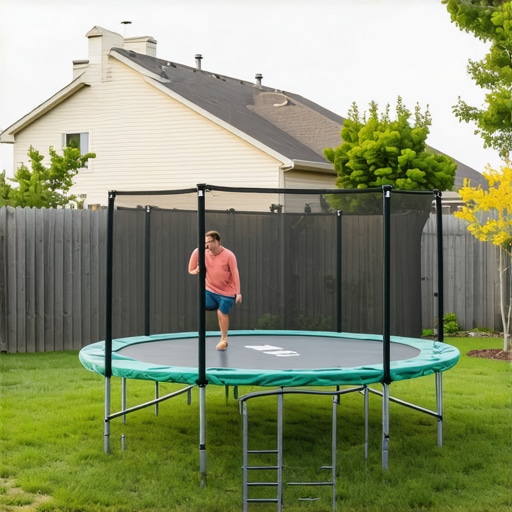
I recently reviewed a $2 million commercial claim that was denied entirely because of a three-word endorsement buried on page 84 that the broker never even mentioned to the client. This is the reality of the indemnity market. Carriers are not your neighbors. They are massive actuarial engines designed to calculate risk and minimize payouts through precise linguistic exclusion. When you drag a thousand dollar trampoline into your backyard, you are not just buying a toy. You are introducing a high-frequency liability vector into a contract that was priced for a static, low-risk residence. My desk is currently buried in files where families lost their entire liability shield because they assumed their agent was their friend. The truth is cold. Your policy is a mathematical fortress, and every unapproved modification is a breach in the walls.
The gravity of an attractive nuisance
A standard homeowner policy often excludes backyard trampolines through specific safety endorsements or prohibited risk lists. If your carrier classifies these devices as an attractive nuisance, they may deny liability claims or cancel your coverage entirely upon discovery. Proper notification and safety equipment are requirements for maintaining valid indemnity. This legal doctrine suggests that a landowner may be held liable for injuries to children trespassing on the land if the injury is caused by an object likely to attract children. The trampoline is the textbook definition of this hazard. Actuaries track the probability of spinal injuries and complex fractures with clinical detachment. They know that a trampoline increases the likelihood of a third-party claim by several orders of magnitude. If a neighborhood child wanders into your yard and breaks a limb, your policy triggers. However, if you failed to disclose the existence of that trampoline, the carrier will look for the non-disclosure clause. They will use the material misrepresentation defense to void the contract. This is not personal. It is just math. The carrier priced your premium based on a backyard with zero attractive nuisances. By adding one, you have changed the risk profile without paying the appropriate premium load. The legal system generally supports the carrier in these instances. They argue that the risk has fundamentally altered the nature of the agreement.
“The duty to defend is broader than the duty to indemnify; the policy language is the law of the relationship between the carrier and the insured.” – Contractual Law Maxim
The ghost in the fine print
Hidden endorsements often strip away coverage for specific recreational equipment like trampolines or swimming pool diving boards. These exclusions are usually found in the late pages of your policy jacket and may not be explicitly highlighted during the initial sales process or annual renewal. I have seen policies where the definition of a dwelling is narrowed to exclude any structures or items that increase the medical payment risk above a certain threshold. The ISO HO-3 form, which is the industry standard for most homes, provides a baseline of coverage that carriers then prune with specific endorsements. One common endorsement is the Trampoline Exclusion Endorsement. It states in blunt terms that no coverage is provided for bodily injury or property damage arising out of the use of a trampoline. This applies even if you have a safety net. The presence of the net does not satisfy the actuarial requirement for risk removal. It only mitigates the severity of the injury, not the frequency of the occurrence. Carriers prefer to eliminate the risk entirely. If your policy contains this language, you are essentially self-insured for any trampoline-related catastrophe. Your million-dollar umbrella policy will not save you either. Umbrellas are follow-form policies. If the primary homeowner policy excludes the risk, the umbrella usually does too. You are standing on a legal precipice without a harness. [image placeholder]
Why your insurance carrier hates gravity
Insurance carriers view trampolines as a Tier 1 Hazard because they generate high-frequency medical claims and high-severity liability lawsuits. Actuarial data shows that trampoline injuries often involve long-term rehabilitation or permanent disability which significantly increases the total loss-cost for the carrier. The physics of a trampoline accident are a nightmare for a forensic underwriter. You have multiple bodies of varying mass moving at different velocities in a confined space. The probability of a kinetic collision is high. When you add the height factor, the potential for cervical spine trauma enters the equation. These are not five hundred dollar claims. These are five hundred thousand dollar claims. Carriers operate on thin margins. They cannot afford to cover a household that doubles its liability risk for a hundred dollars a month in premium. While most people think a higher premium means better insurance, the truth is that carriers often raise prices on loyal customers while stripping away silent coverage in the fine print. They want the premium, but they do not want the risk. This creates a systemic tension where the insured believes they are protected while the carrier has already prepared the denial letter in the event of a specific incident. The disconnect between consumer expectation and contractual reality is where I spend most of my professional life.
The mathematical reality of a medical payout
Calculating the financial exposure of a backyard injury requires an understanding of Coverage E and Coverage F within your policy. Coverage E handles personal liability for major lawsuits, while Coverage F handles smaller medical payments regardless of fault or negligence. Below is a comparison of how these coverages interact with trampoline risks.
| Feature | Actual Cash Value Basis | Replacement Cost Basis | Trampoline Impact |
|---|---|---|---|
| Coverage E (Liability) | Subject to depreciation | Full limit available | Often excluded via endorsement |
| Coverage F (Medical) | No fault required | Fixed low limits | Strictly capped or voided |
| Deductible Applied | Yes | Yes | May be tripled for high risk |
| Legal Defense Costs | Outside limits | Inside limits | Denied if risk was undisclosed |
As the table demonstrates, the distinction between these coverages is vital. If a child is injured, Coverage F might pay for the initial emergency room visit without a lawsuit. But if the injury leads to a permanent disability, the family will likely sue under Coverage E. If your trampoline is on the exclusion list, the carrier will refuse to provide a legal defense. You will be paying for a high-stakes litigation lawyer out of your own pocket. This is where the true financial ruin happens. The legal fees alone can bankrupt a middle-class family before the case even reaches a jury. The carrier will cite the exclusionary language and leave you to navigate the civil court system alone.
“Insurance is a contract of adhesion where any ambiguity must be construed against the drafter to protect the reasonable expectations of the insured.” – ISO Regulatory Principle
The subrogation trap behind the net
Subrogation occurs when your insurance company pays your claim and then sues a third party to recover the money. In trampoline cases, this often involves the carrier suing the manufacturer or the neighbor who was supervising the children. I watched a client lose their right to recover damages from a negligent contractor because they signed a waiver of subrogation in a simple service contract without realizing they were voiding their own insurance coverage. This happens with trampolines too. If you buy a trampoline and sign a waiver from the installation company, you might be violating your policy terms. Your carrier has a right to subrogate against negligent parties. If you sign away that right, you have impaired the carrier’s ability to recover their loss. They can use this as a reason to deny your claim. They will argue that you breached the cooperation clause of the contract. This is a technical trap that few homeowners understand. The interaction between your homeowner policy and the commercial liability of the trampoline manufacturer is a complex web of indemnity. One wrong signature on a delivery form can nullify your primary protection. Forensic underwriters look for these signatures during the discovery phase of a claim. They want to find any reason to shift the financial burden away from the carrier’s balance sheet.
The three words that kill a claim
Specific phrases like arising out of or resulting from are used in insurance contracts to broadly exclude any event connected to a prohibited item. These phrases ensure that even indirect injuries related to a trampoline are not covered. If a child trips on the frame of the trampoline while it is sitting unused in the yard, the carrier will argue the injury arose out of the existence of the trampoline. It does not matter that no one was jumping. The mere presence of the hazard is the proximate cause of the risk. This linguistic precision is how carriers win in court. They do not use vague language. They use terms that have been tested in appellate courts for decades. When you see an endorsement that excludes liability arising out of specialized play equipment, you must realize that it covers every possible scenario involving that equipment. There is no middle ground. There is no nuance. The contract is a binary switch. Either the risk is covered or it is not. Most homeowners treat their policy like a buffet where they can pick and choose what they disclose. In reality, the policy is an all-or-nothing proposition. Any failure to disclose a material change in risk allows the carrier to hit the kill switch on your entire liability section.
A tactical plan for hazard mitigation
Reviewing your policy for trampoline coverage requires a forensic approach to your declarations page and all attached endorsements. You must confirm in writing that your carrier accepts the risk and that you are meeting all safety prerequisites. Use this checklist to audit your current position.
- Request a copy of the specific Trampoline Endorsement from your agent.
- Confirm if your policy requires a four-foot or six-foot perimeter fence with a locking gate.
- Verify if the use of a safety net is a condition of coverage rather than just a suggestion.
- Ensure the trampoline is anchored to the ground using professional-grade hardware.
- Check if your personal umbrella policy specifically lists the trampoline as an underlying risk.
- Document the removal of any ladders when the trampoline is not in active use.
- Obtain written confirmation from your carrier that the trampoline does not void your medical payments coverage.
If you cannot check every box on this list, you are likely in a state of under-insurance or non-insurance. Do not take the word of a customer service representative over the phone. They do not have the authority to override the written contract. You need an endorsement on your declarations page. If it is not in the written document, it does not exist in the eyes of the law. This is the blunt truth that most people ignore until they are served with a lawsuit. The cost of a few phone calls and a possible premium increase is nothing compared to the cost of a total loss of your assets. The insurance market is hardening. Carriers are looking for any excuse to shed high-risk clients. Do not give them an easy exit by hiding a trampoline in your backyard.
The legal fiction of full coverage
The term full coverage is a marketing myth used by agents to simplify a complex legal document. Every policy has limits, exclusions, and conditions that define the boundaries of protection. In the forensic world, we know that no one is truly fully covered. You are only as protected as the language in your specific manuscript policy allows. A trampoline is a perfect example of how this fiction falls apart. You can pay your premiums for twenty years and never miss a beat. But the moment you introduce a risk that the carrier has decided they no longer want to underwrite, your decades of loyalty mean nothing. They will point to the exclusion. They will point to the non-disclosure. They will walk away from the table. My job is to see the gaps before the accident happens. Your job is to stop treating your insurance policy like a utility bill and start treating it like the high-stakes legal contract that it is. Read the exclusions. Challenge the endorsements. Demand clarity. If your carrier refuses to cover your trampoline, you have two choices. You can get rid of the trampoline, or you can find a carrier that specializes in high-risk residential indemnity. Anything else is just gambling with your family’s financial future. The house always wins when the rules are written in the fine print.