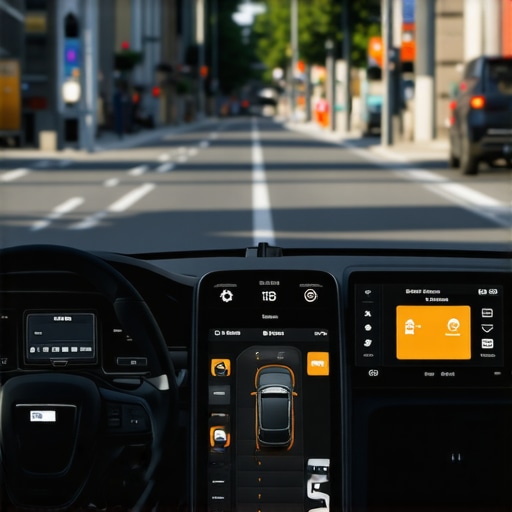
The aroma of burnt coffee and the clinical hum of the fluorescent lights in my office usually accompany a forensic audit. For 25 years, I have deconstructed the math of risk. I recently reviewed a high-limit auto claim where a simple parking lot bump, the kind that used to cost five hundred dollars, turned into a twenty thousand dollar total loss. The reason was a three-word endorsement regarding sensor calibration that the broker never explained. The owner thought they were buying safety. In reality, they were buying an uninsurable liability. This is the cold reality of the modern insurance market. Your car is no longer a machine of steel and rubber. It is a fragile mobile computer system designed by engineers who do not care about your premiums.
The technological trap inside your bumper
Advanced safety features increase car insurance rates because the cost of repairing sensors, cameras, and lidar systems far exceeds the traditional costs of bodywork. When a bumper is dented today, it is not just plastic that is damaged. It is the sophisticated array of ultrasonic sensors and short-range radar units that must be replaced and recalibrated to exacting manufacturer standards. The actuarial data is clear. Frequency of accidents is down, but severity of loss is up. This shift in the loss-cost model forces carriers to raise base rates across the board to account for the specialized labor and parts required for even the most minor cosmetic repairs.
“The property damage severity is driven by the rising cost of parts and the increased labor hours required for diagnostic resets and system recalibrations.” – National Association of Insurance Commissioners (NAIC)
Consider the windshield. Ten years ago, a stone chip meant a hundred dollar repair or a three hundred dollar replacement. Today, that same windshield acts as an optical lens for the Forward-Facing Camera (FFC) used in lane-keep assist and emergency braking. If you replace it with non-OEM glass, the refractive index might be off by a fraction of a millimeter. The system fails. The car cannot be safely operated. To fix it, you need a specialized technician with a targets-and-lasers setup. This recalibration alone can cost more than the glass itself. The insurance carrier sees this as a systemic risk. They are not just insuring a piece of glass. They are insuring a complex vision system.
Actuarial reality of the electronic crumple zone
Actuaries calculate car insurance premiums by analyzing the total cost of parts and the specific labor rates required for high-tech vehicle restoration. While modern safety tech prevents low-speed collisions, the cost to repair the vehicle when a collision does occur has scaled exponentially. We are seeing a trend where vehicles are declared a total loss at much lower impact speeds. The threshold for a total loss is typically sixty to seventy-five percent of the vehicle value. With sensor arrays costing five thousand dollars per corner, reaching that threshold is shockingly easy. This increases the carrier’s net payout on what should have been a simple repair.
| Vehicle Component | 2014 Repair Cost (Est.) | 2024 Repair Cost (Est.) |
|---|---|---|
| Front Bumper Assembly | $650 | $4,200 |
| Side Mirror Replacement | $150 | $1,100 |
| Windshield Replacement | $300 | $1,800 |
| Headlight Assembly | $250 | $2,500 |
The math is brutal. In the Balkanized insurance markets or the high-litigation environments of Florida, these costs are magnified by the scarcity of certified technicians. If your car requires a Level 3 Diagnostic Technician to reset the blind-spot monitors, and there are only two such technicians in your region, the labor rate spikes. The insurer passes this cost directly to you. They do not care about your safety rating. They care about the forensic trace of the repair bill. If a headlight now costs more than a used engine, the premium must reflect that liability.
The ghost in the fine print
Insurance policy language often contains exclusions for specialized software updates and proprietary calibration procedures that are necessary after a collision. Many policyholders believe they have full coverage, but they are actually victims of a mathematical fiction. If your policy only covers “Market Value” repairs and uses “Aftermarket Parts” language, you are in danger. Many safety systems will only function with Original Equipment Manufacturer (OEM) parts. If the insurer refuses to pay for the OEM sensor, and the aftermarket sensor cannot be calibrated, you are left with a car that is technically repaired but legally and functionally unsafe to drive.
“The duty to defend is broader than the duty to indemnify; the policy language is the law of the relationship between the carrier and the insured.” – Contractual Law Maxim
The carrier’s leverage lies in the subrogation process. If another driver hits you, your insurer will try to recover the costs from their carrier. However, if the repair costs are inflated due to