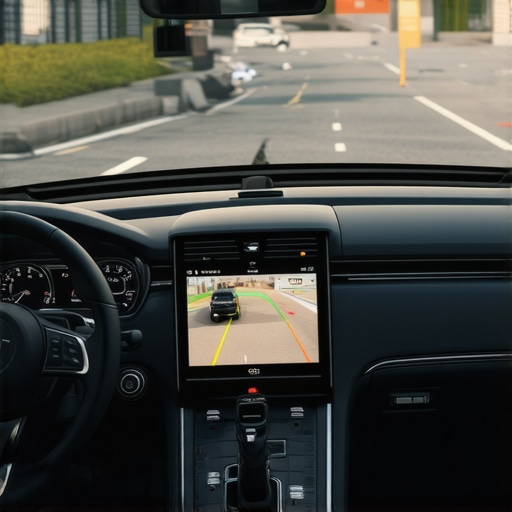
The invisible failure of the silicon eye
Proving sensor failure requires the forensic retrieval of Event Data Recorder (EDR) telematics and Diagnostic Trouble Codes (DTC) that demonstrate a mismatch between environmental input and mechanical response. This digital evidence overrides standard police reports by providing a timestamped log of system blindness or logic errors during the impact sequence. I watched a client lose their right to recover damages from a negligent contractor because they signed a waiver of subrogation in a simple service contract without realizing they were voiding their own insurance coverage. This happened because the contractor had incorrectly recalibrated the Forward Collision Warning system. When the sensors failed to trigger the Autonomous Emergency Braking, the vehicle struck a barrier at fifty miles per hour. The carrier denied the claim under a mechanical failure exclusion, and because of that waiver, the client could not sue the shop that caused the misalignment. This is the reality of the modern insurance fortress. The car didn’t stop because the code failed. The carrier won’t pay because the code is not a person they can easily subrogate against. You are trapped between a software glitch and a contractual void. Success in these claims depends on your ability to treat the vehicle not as a machine, but as a digital crime scene. Most adjusters are trained to look at bent metal. They are not trained to interpret the hex code of a Controller Area Network bus failure. To win, you must force them to look at the math.
The black box is your only witness
The Event Data Recorder (EDR) captures critical telemetry including brake pedal position, steering angle, and wheel speed for several seconds before a crash. If your safety sensors failed, the EDR will show that the driver did not intervene because the system was supposed to handle the hazard. I have seen hundreds of cases where the insurer blamed driver inattentiveness when the actual cause was a ghost braking event or a sensor blind spot.
“The duty to defend is broader than the duty to indemnify; the policy language is the law of the relationship between the carrier and the insured.” – Contractual Law Maxim
This legal reality means the burden of proof for a product defect often falls on the insured during the initial investigation phase. You must secure the vehicle immediately. Once a car is totaled and sent to a salvage yard, the data is frequently lost or the EDR is overwritten. Forensic engineers use specialized tools like the Bosch Crash Data Retrieval system to pull this information. If the sensors were inactive or sent a False Negative signal, the logs will show a lack of system activation despite the presence of a target in the radar’s field of view. This is not just about the crash. It is about the seconds leading up to it. The actuarial probability of a sensor failure is low, which is why carriers are so dismissive of these claims. They rely on the statistical likelihood that you were texting. You must provide the data that proves you were not.
The liability shift from driver to manufacturer
When a safety sensor fails, the legal liability shifts from simple driver negligence to a complex product liability claim involving the OEM or a third-party service provider. This transition is where most car insurance policies become problematic because standard personal auto forms are not designed to litigate against multi-billion dollar tech giants. Carriers will often settle for policy limits rather than fund a three year investigation into a LIDAR defect. This leaves the victim with a massive shortfall if the damages exceed the standard coverage. In states like Florida or California, the litigation environment makes this even more volatile. If you have an Assignment of Benefits clause in your repair contract, you might have already signed away your right to control the data retrieval process.
“Insurance rates shall not be excessive, inadequate or unfairly discriminatory, and the risk must be accurately classified to maintain solvency.” – NAIC Model Law Principle
The irony is that your premium includes a surcharge for these safety features, yet the carrier will use their complexity to deny your claim. They view the sensor as a luxury, not a critical safety component. If the sensor fails, they treat it like a broken radio unless you can prove the failure was the proximate cause of the injury.
A technical comparison of sensor data reliability
Understanding which sensors failed is the first step in a forensic audit. Different systems leave different digital footprints. Radar and LIDAR have distinct failure modes that require specific expert testimony to validate in a court of law.
| Sensor Type | Failure Mode | Evidentiary Weight | Data Source |
|---|---|---|---|
| Ultrasonic | Signal interference | Medium | Park Assist Logs |
| Radar | Target misclassification | High | ADCM Records |
| LIDAR | Environmental blindness | Very High | Object Detection Lists |
| Monocular Camera | Optical occlusion | High | Image Processor Hex |
As shown in the table, Radar and LIDAR provide the most robust data for legal proceedings. If the Radar detected an object but the logic board decided it was a false positive, that is a software defect. If the camera was blinded by sun glare and did not trigger the brakes, that is a known limitation that the manufacturer may be liable for if they did not provide adequate warnings. The insurance carrier will ignore these nuances. They will look at the police report which says you hit a car from behind. In the eyes of the law, the rear ender is almost always at fault. Only the data can flip that script.
The digital crime scene preservation checklist
To preserve your rights after a collision involving failed technology, you must follow a strict protocol. Do not trust the insurance company to do this for you. Their interest is in closing the file at the lowest possible cost.
- Request an immediate litigation hold on the vehicle’s internal computer systems.
- Do not permit any firmware updates or software patches after the collision.
- Obtain the calibration records from the last time the vehicle was serviced.
- Identify if any aftermarket glass or body parts were installed that could interfere with sensor fields of view.
- Hire a private forensic engineer before the carrier’s adjuster reaches the lot.
- Document the weather conditions and sun position to rule out environmental occlusion.
The carrier will try to move the car to a yard they control. Once that happens, your access to the EDR becomes a matter of litigation rather than a matter of right. They will use the delay to their advantage. They know that every day that passes makes the digital trail colder. This is not about being a difficult claimant. This is about protecting the mathematical truth of the event. The insurance industry is built on the management of uncertainty. When you provide the EDR report, you remove that uncertainty and force them to deal with the facts of the failure.
Why your full coverage is a mathematical fiction
The term full coverage is a marketing lie used to sell premiums to people who don’t read endorsements. In the context of safety sensors, your policy likely has a mechanical breakdown exclusion. If the sensor simply stopped working due to a defect and you hit a wall, the carrier might argue the collision was a result of a non-covered mechanical failure rather than a covered accidental peril. This is the kind of forensic hair-splitting that costs people hundreds of thousands of dollars. They want to decouple the sensor failure from the accident. They will claim the failure happened first, and therefore, the subsequent crash is an uncovered consequence. It is a disgusting tactic, but it is standard operating procedure for high-limit defense teams. You must demonstrate that the sensor was an integral part of the vehicle’s operational safety and that its failure constituted a sudden and accidental loss. This requires a deep dive into the ISO definitions of equipment. You need to prove the sensor is not a wear-and-tear item like a brake pad, but a permanent electronic component. The moment you let them classify a sensor failure as maintenance, you lose the claim. I have seen it happen to the most prepared drivers. They trust the system. They trust the brand. Then the silicon fails, and the paper contract fails right along with it.